With globalization, multinational enterprises (MNEs) frequently engage in cross-border transactions involving goods, services, and intangibles between their associated enterprises (AEs). To prevent base erosion and profit shifting, tax authorities globally, including India, heavily scrutinize these transactions.
The core principle of Transfer Pricing (TP) in India is that any transaction between AEs must be conducted at an Arm's Length Price (ALP)—the price that would be charged if the parties were entirely independent.
Maintaining robust TP documentation is not just a best practice; it is a statutory requirement under the Income Tax Act, 1961. Failure to do so attracts severe penalties.
The 3-Tier Transfer Pricing Documentation Structure
In line with the OECD’s BEPS Action 13 guidelines, India follows a three-tiered documentation structure for large multinationals:
- Country-by-Country Report (CbCR): Applicable to MNEs with consolidated global revenue exceeding €750M (approx. ₹6,400 Crores).
- Master File: Required if consolidated global revenue exceeds ₹500 Crores AND international transactions exceed ₹50 Crores (or ₹10 Crores for intangibles).
- Local File (TP Study Report): Mandatory for all taxpayers whose international transactions exceed ₹1 Crore.
Comprehensive Local File Checklist (The TP Study)
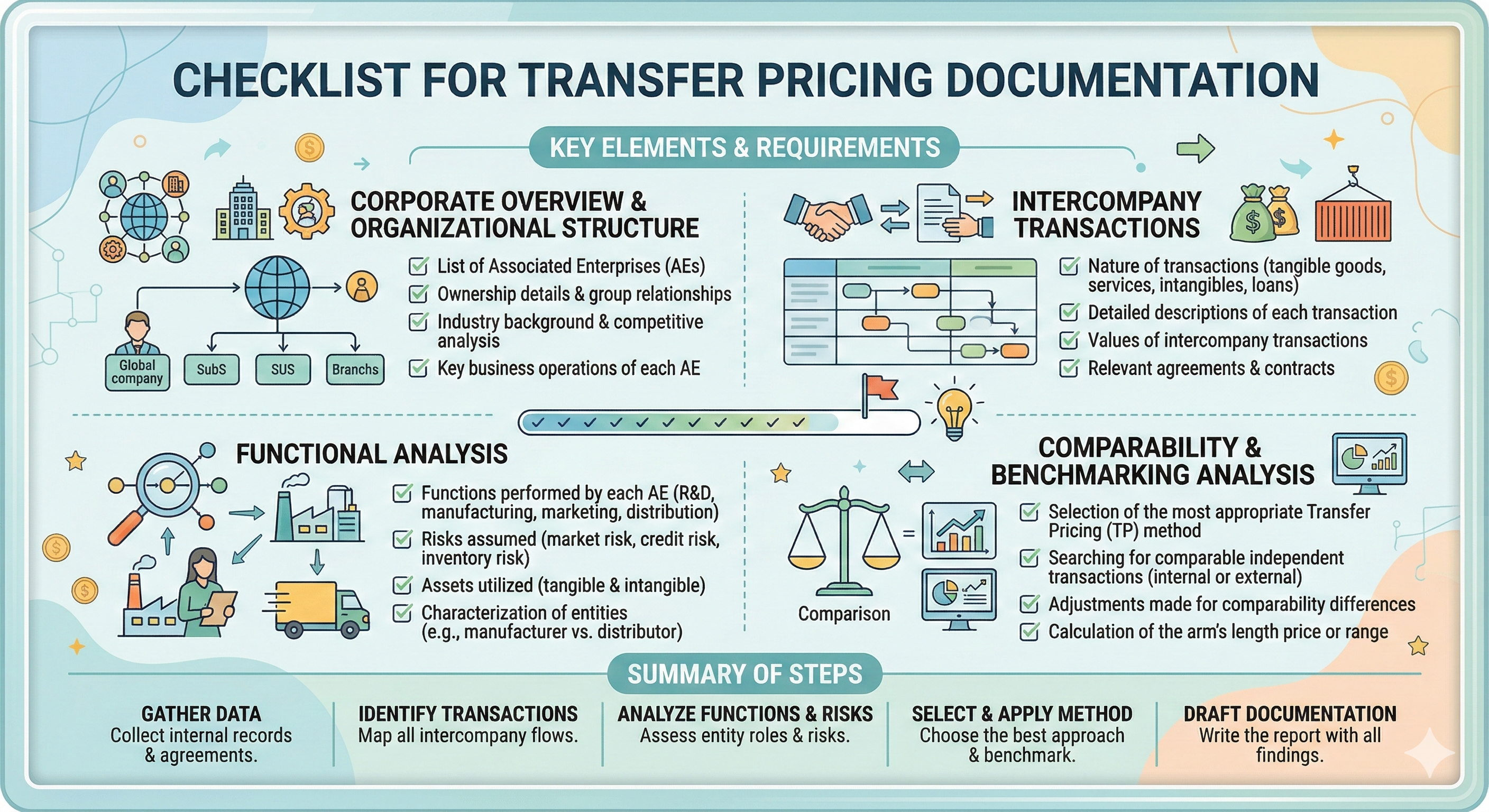
For most mid-sized enterprises and Indian subsidiaries of foreign companies, the Local File (Section 92D) is the primary focus. Ensure your documentation includes the following:
1. Entity and Industry Analysis
- Profile of the MNE Group: Ownership structure, global footprint, and principal business activities.
- Profile of the Indian Taxpayer: Detailed description of the business, operational structure, and strategic goals.
- Industry Analysis: Overview of the industry, macroeconomic factors, market trends, and the competitive landscape in which the Indian entity operates.
2. Intercompany Transactions
- Details of Associated Enterprises: Names, addresses, and relationships of all AEs involved in transactions.
- Nature of Transactions: Comprehensive list of all international transactions (e.g., import of raw materials, export of IT services, royalty payments, corporate guarantee fees, management cross-charges).
- Transaction Volume: Quantum and value of each transaction as recorded in the books of accounts.
- Contracts & Agreements: Copies of all intercompany agreements justifying the terms of the transactions.
3. Functions, Assets, and Risks (FAR) Analysis
This is the heart of the TP study. It determines the true economic characterization of the entities involved.
- Functions Performed: Who does what? (e.g., R&D, manufacturing, marketing, distribution).
- Assets Employed: Tangible assets (machinery) and Intangible assets (patents, brand value) used by each entity.
- Risks Assumed: Who bears the market risk, credit risk, forex risk, or inventory risk?
4. Economic Analysis (Benchmarking)
- Selection of the Tested Party: Usually the entity with the simplest FAR profile.
- Selection of Most Appropriate Method (MAM): Justification for choosing CUP, RPM, CPM, PSM, or TNMM. TNMM (Transactional Net Margin Method) is the most commonly used.
- Search for Comparables: Details of the database used (e.g., Prowess, Capitaline) and the accept/reject matrix for selecting independent comparable companies.
- Arm's Length Calculation: Computation of the Profit Level Indicator (PLI) of the tested party against the ALP range (35th to 65th percentile) of the comparables.
Accountant's Report (Form 3CEB)
In addition to the TP study, every person entering into an international transaction must obtain a report from a Chartered Accountant in Form 3CEB and file it on or before October 31st of the assessment year.
Transfer Pricing assessments are highly litigious. Proactive and meticulously crafted documentation is your best defense. Our International Taxation team at A K Shrivastava & Associates specializes in preparing robust TP studies and defending them before revenue authorities.