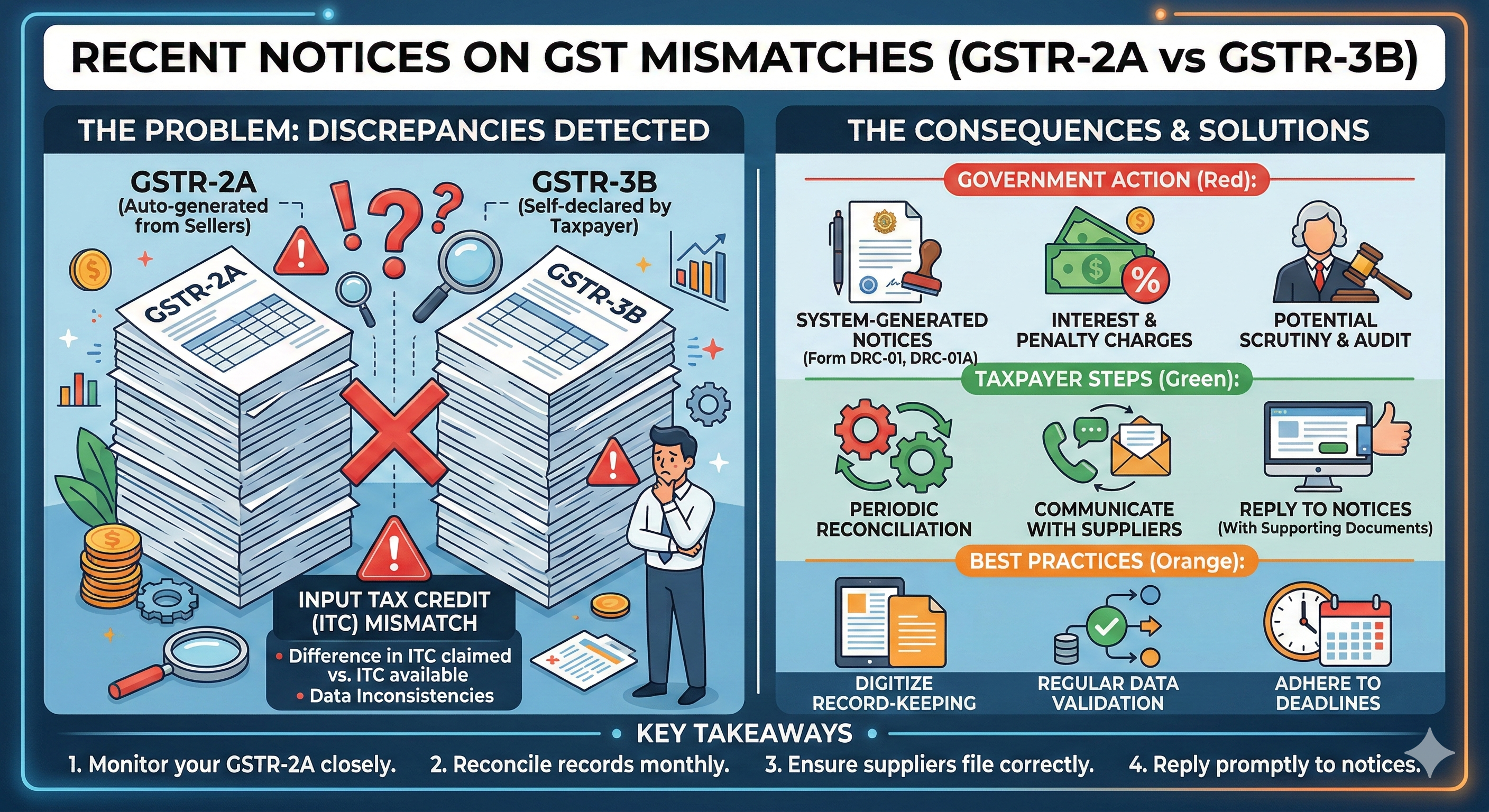
The Goods and Services Tax (GST) landscape in India relies heavily on automated matching concepts to prevent revenue leakage. One of the most common causes of stress for taxpayers is receiving an ASMT-10 or a show-cause notice under Section 73/74 for discrepancies between GSTR-2A/2B and GSTR-3B.
Understanding why these notices are triggered and how to handle them is critical for any business claiming Input Tax Credit (ITC).
The Root Cause of Mismatches
The GST portal matches the ITC claimed by the purchaser in GSTR-3B with the outward supplies declared by the supplier in GSTR-1 (which auto-populates GSTR-2A and GSTR-2B). Mismatches typically occur due to:
- Supplier Default: Your vendor failed to file their GSTR-1 or filed it late (after you claimed the credit).
- Clerical Errors: Incorrect GSTIN, invoice numbers, or monetary values entered by the supplier.
- Timing Differences: An invoice was recorded in your books in March, but the supplier uploaded it in their April return.
- Place of Supply Errors: Supplier treating an inter-state supply as intra-state or vice versa.
How to Respond to a Departmental Notice
When you receive a notice highlighting a mismatch, panic is not the solution. Systematic reconciliation is.
Step 1: Perform Detailed Reconciliation Generate a year-to-date (YTD) reconciliation between your purchase register, GSTR-3B filed, and GSTR-2A/2B downloaded from the portal. Identify the exact invoices causing the variance.
Step 2: Communicate with Suppliers For missing invoices, contact the respective vendors immediately. If they have failed to file or filed incorrectly, request them to amend their next GSTR-1. Provide this communication as evidence to the assessing officer showing bona fide intent.
Step 3: Draft a Point-wise Reply Submit your reply in Form GST ASMT-11 within the stipulated time (usually 30 days). Your reply should categorize the mismatch:
- Invoices missed by supplier (Attach vendor communication).
- Invoices claimed in subsequent months (Provide reconciliation mapping).
- Errors in data entry (Attach correct invoices).
The Legal Standpoint on ITC Mismatches
The courts have increasingly taken a pragmatic view. The Supreme Court and various High Courts have held that a bona fide purchasing dealer cannot be automatically penalized or denied ITC simply because the selling dealer failed to deposit the tax, provided the purchaser has fulfilled the core conditions of Section 16 (possession of tax invoice, receipt of goods/services, payment made to supplier).
However, you must be prepared to prove that the transaction was genuine and not a paper transaction.
Preventive Strategies for Businesses
To avoid these notices altogether, businesses should implement robust internal controls:
- Vendor Compliance Tracking: Make vendor payments contingent upon the successful reflection of the invoice in GSTR-2B.
- Monthly Reconciliations: Do not wait for the year-end. Reconcile GSTR-2B with purchase registers every month before filing GSTR-3B.
- Automated Tools: Utilize GST reconciliation software to identify mismatches instantly and send bulk reminders to non-compliant vendors.
Need assistance dealing with a GST notice or setting up an automated reconciliation process? Contact A K Shrivastava & Associates for expert representation and advisory.