With the recent Union Budget 2026 announcements and the highly anticipated New Income Tax Act set to take effect from April 1, 2026, the Indian taxation landscape is shifting toward simplicity. However, the quintessential dilemma remains for every salaried professional and business owner: Should you stick with the Old Tax Regime or transition to the New Tax Regime?
At A K Shrivastava & Associates, we understand that tax planning is not a one-size-fits-all approach. Choosing the right regime can drastically impact your take-home salary and annual savings. Here is a comprehensive breakdown of both regimes for the Financial Year 2026-27 (Assessment Year 2027-28) to help you make an informed financial decision.
1. The New Tax Regime: The Default Standard
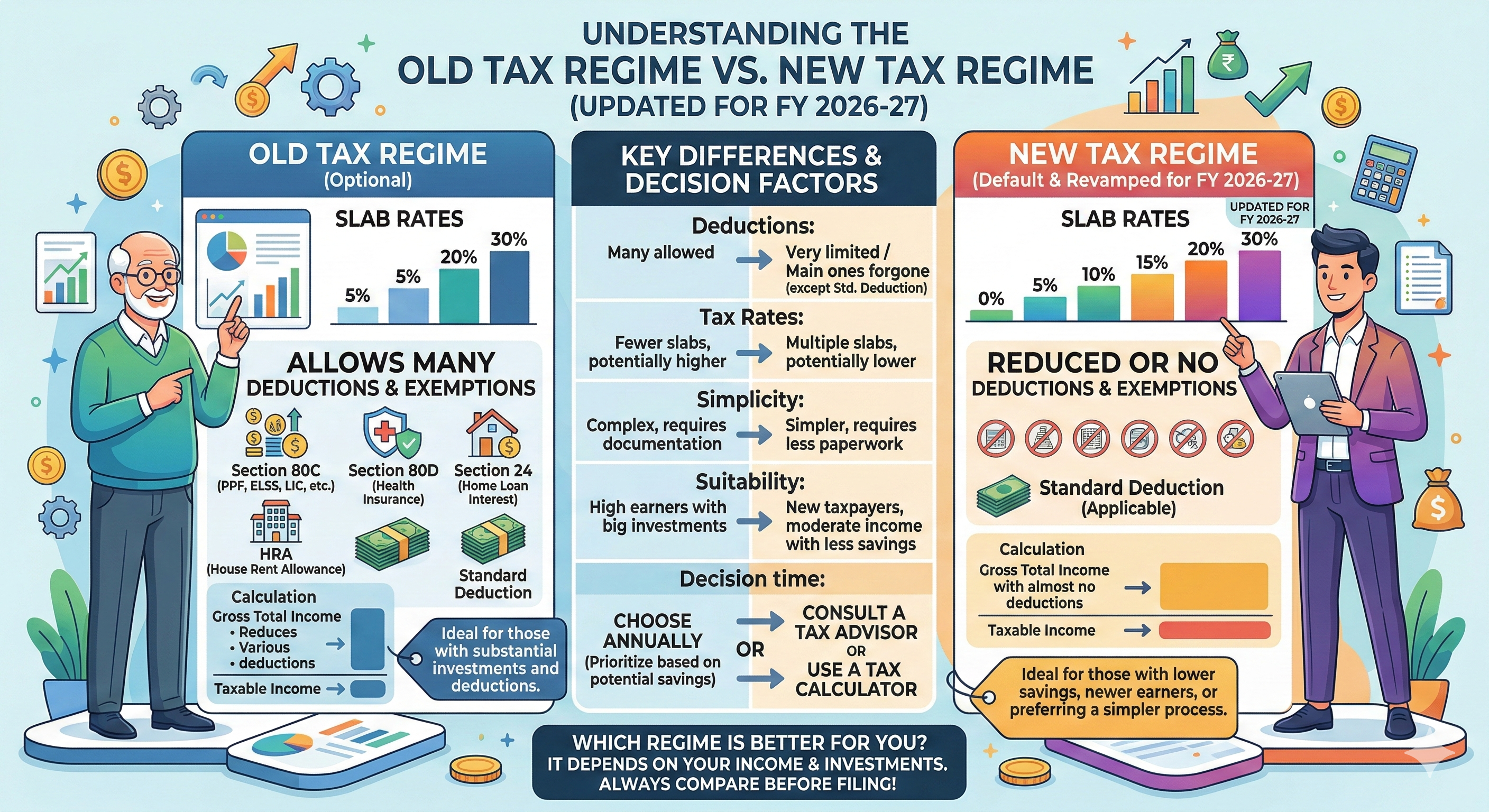
The New Tax Regime was designed to simplify tax compliance by offering lower tax rates in exchange for letting go of most traditional deductions. As of the latest regulations, this is the default tax regime. If you do not explicitly inform your employer or choose the old regime while filing your ITR, your taxes will automatically be calculated under this new structure.
Key Highlights for FY 2026-27:
- Zero Tax up to ₹12 Lakh: Thanks to the enhanced Section 87A rebate (up to ₹60,000), resident individuals with a taxable income of up to ₹12,00,000 pay nil tax.
- Higher Standard Deduction: Salaried individuals and pensioners enjoy a standard deduction of ₹75,000. This effectively makes a salary of up to ₹12,75,000 completely tax-free.
- Surcharge Capped: For high-net-worth individuals earning over ₹5 Crore, the maximum surcharge rate is capped at 25% (down from 37% in the old regime).
Income Tax Slabs (New Regime):
- Up to ₹4,00,000: Nil
- ₹4,00,001 to ₹8,00,000: 5%
- ₹8,00,001 to ₹12,00,000: 10%
- ₹12,00,001 to ₹16,00,000: 15%
- ₹16,00,001 to ₹20,00,000: 20%
- ₹20,00,001 to ₹24,00,000: 25%
- Above ₹24,00,000: 30%
2. The Old Tax Regime: The Deductions Route
The Old Tax Regime continues to be the preferred choice for taxpayers who aggressively invest in tax-saving instruments. While the tax slab rates are steeper, the regime allows you to shrink your taxable income using over 70 different exemptions and deductions. Furthermore, the proposed Draft Income Tax Rules 2026 aim to bring meaningful upgrades to the old regime by broadening HRA exemptions and updating allowance limits.
Key Highlights for FY 2026-27:
- Tax-Free up to ₹5 Lakh: A rebate of ₹12,500 under Section 87A makes income up to ₹5,00,000 tax-free.
- Standard Deduction: Remains at ₹50,000 for salaried employees.
- Wealth of Deductions: You can claim substantial benefits under Section 80C (up to ₹1.5L for PF, ELSS, LIC), Section 80D (Health Insurance), Section 24(b) (Home Loan Interest up to ₹2L), HRA, and LTA.
3. Head-to-Head Comparison
| Feature | New Tax Regime (FY 2026-27) | Old Tax Regime (FY 2026-27) | | :--- | :--- | :--- | | Default Status | Yes | No (Must be explicitly chosen) | | Basic Exemption Limit | ₹4,00,000 | ₹2,50,000 (Below 60 years) | | Tax-Free Income (with Rebate) | Up to ₹12,00,000 | Up to ₹5,00,000 | | Standard Deduction (Salaried) | ₹75,000 | ₹50,000 | | Sec 80C, 80D, HRA, LTA | Not Allowed | Allowed | | Home Loan Interest | Not Allowed (Self-Occupied) | Allowed (Up to ₹2,00,000) | | Switching Rules (Business) | Once opted out, can only switch back once in a lifetime. | N/A | | Switching Rules (Salaried) | Can switch every year. | Can switch every year. |
4. Which Regime Should You Choose?
The "better" regime entirely depends on your financial profile, investment habits, and specific income level.
Choose the New Tax Regime if:
- Your total income is up to ₹12.75 lakh (salaried) or ₹12 lakh (non-salaried).
- You prefer higher in-hand liquidity and do not want to lock your capital into specific tax-saving investments like PPF or ELSS just to save tax.
- You are a high-income earner wanting to benefit from the reduced surcharge rates.
Choose the Old Tax Regime if:
- You maximize your Section 80C limit (₹1.5 Lakh).
- You pay substantial rent and can claim a high House Rent Allowance (HRA) exemption.
- You are servicing a home loan and can claim the ₹2 Lakh interest deduction.
- You pay high premiums for medical insurance for your family and senior citizen parents (Section 80D).
The Golden Rule: Always calculate your tax liability under both regimes before filing. If your total eligible deductions exceed the "break-even" threshold for your specific salary bracket, the old regime will save you money. Otherwise, the new regime is more efficient.
Need Expert Tax Planning? At A K Shrivastava & Associates, we help individuals and businesses optimize their tax outflow through strategic planning and flawless compliance. Contact our office today to structure your finances for the upcoming fiscal year.